
Every tech has walked into a call expecting a quick win, only to find the system doing its own thing. Happens to the best of us. Misdiagnoses burn daylight and parts budgets, but most follow repeatable patterns. Once you know those patterns, you stop chasing mystery problems and start wrapping up calls faster.
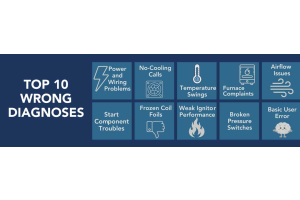
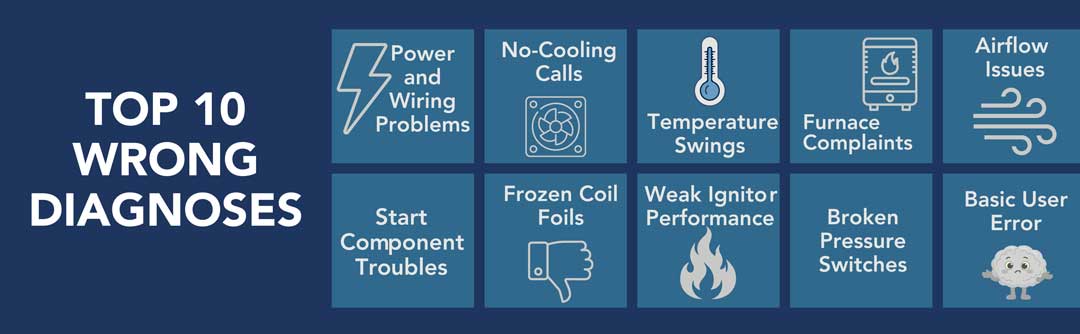
Here are our top 10 heavy hitters that trip up even experienced HVAC pros:
- Control boards blamed for everything
A furnace locks out or a condenser acts strange and the board gets framed on the spot. Half the time the real issue is a poor connection, a weak transformer or voltage swings. Always rule out power and wiring before dropping serious money on a new board. - No cooling misattributed to refrigerant loss
Warm house calls often get labeled as leaks. In reality, airflow issues cause far more “no cool” complaints. Dirty coils, clogged filters or a parked-out blower can mimic a low-charge system. Verify airflow before touching gauges. - Furnace complaints blamed on failed heat exchangers
Not every heating issue is a cracked exchanger. Pressure switch restrictions, inducer problems and simple vent blockages create symptoms that look serious. Inspect the basics before writing up a major repair. - Bad compressors diagnosed too fast
A system not starting does not automatically mean a dead compressor. Weak capacitors, failing contactors and loose wiring cause more false alarms than actual mechanical failure. Test start components before calling for the crane. - Thermostats blamed for temperature swings
Customers love blaming thermostats. Many techs do, too. More often the culprit is a cycling issue, poor sensor placement or a failing igniter in gas heat. Watch the system behavior before chasing the wall control. - Poor airflow pinned on the blower
If airflow is weak, the blower becomes a common suspect. But blocked returns, collapsed ductwork and dirty evaporator coils cause more headaches than the motor itself. Check the path the air has to travel before pricing a blower assembly. - Frozen coils chalked up to refrigerant problems
A frozen coil can look like a refrigerant issue. Low airflow, faulty fan motors or clogged filters create freeze-ups that have nothing to do with charge. Clear restrictions and verify airflow first. - Flame sensor swaps when the igniter is the real issue
Furnaces that short-cycle or fail to light often get new flame sensors for no reason. Slow or weak igniters cause more ignition problems than sensors. Watch the ignition sequence before calling the sensor guilty. - Pressure switches overlooked
If a furnace refuses to fire, the pressure switch sits quietly in the corner while everything else gets tested. Kinked hoses, restricted inducers or vent issues often lead straight back to that switch. Test it early and you save steps. - Misdiagnoses caused by customer settings
A surprising share of system failures start with a thermostat on the wrong mode or vents closed in half the house. A quick walkthrough solves issues faster than opening the tool bag. It also keeps a return visit off your schedule.
Remember, slowing down in the first five minutes will save you the next thirty. And if you ever need the right part in a hurry? We’ll have it pulled before you even finish the sentence.